

Cloudflare Radar puts bots at more than a third of all web traffic today.
Search indexing, price monitoring, ad verification, AI-driven data retrieval, market intelligence, and other automated workflows all rely on high-volume access across regions.
If you run a VPN, proxy, crawling, or scraping platform, that traffic is central to your business. Although demand can spike quickly between markets, customers still expect the same access quality wherever they use your services. Maintaining that service consistency means having enough capacity, stable performance, and a regional environment that can grow with demand.
Infrastructure planning for access-heavy platforms now have to factor in where requests actually originate and terminate, how much volume they generate, and whether the region can hold up once real customer traffic lands on it.
This is the first part of our three-part series on evaluating infrastructure for access-heavy platforms. Check out Part 2 and Part 3.
Distributed traffic constantly tests regional infrastructure
Run one workload in two markets and you’ll get two different outcomes based on distance to the origin, the network path, and how much local capacity is available.
For VPN and proxy, this looks like slower connections, sessions that drop, complaints piling up around one specific market while everything else is fine. For crawling and scraping, it’s jobs running longer, success rates dipping unexpectedly, or throughput that won’t hold steady across a target region.
Local network conditions like carrier quality, peering reach, IP availability, routing stability, and bandwidth capacity all influence how smoothly traffic moves through a market.
Backhauling through a few central cloud regions may seem easier at first but stops working so well as your footprint grows. Every extra hop through an inefficient path adds latency and congestion on top of traffic that was already hard to predict.
A customer could need a proxy capacity bump in one country for a three-week project. A crawler might spike around a single market and go quiet again. VPN usage can jump because a country changed a policy or a service goes down in one market. Some workloads are steady while others are bursty, making historical usage a less trustworthy blueprint.
And when traffic grows, besides scaling bandwidth, you’ll also need more compute, hardware, IP, power, and data center capacity.
Let one of those lag and it holds back your entire deployment, leading to capacity getting purchased reactively at a worse price, a region that was stable a month ago starting to buckle once production traffic hits, or a customer’s expansion sitting stalled behind a hardware order that wasn’t planned early enough.
Flexible regional compute gives you more room to respond. You can launch in a market, test real demand, add capacity as usage changes, and validate the broader infrastructure environment before committing to a larger production footprint.
Developed markets can still be challenging to scale
The US, Germany, the Netherlands, Singapore, and France account for the largest shares of bot traffic on Cloudflare Radar.
These markets are well connected, high volume, and surprisingly difficult to scale in because growth is still gated by hardware availability, IP inventory, data center capacity, bandwidth pricing, and how long it takes a provider to turn your provisioning request around.
Public clouds add their own friction with hyperscalers setting quotas on how much IPv4 space an account or instance can use, making it challenging to secure enough addresses for growth. High-volume automated traffic can also trigger a hyperscaler’s abuse-detection systems even when the activity is legitimate and compliant. And the pricing often works against access-heavy platforms like VPN, proxy, crawling, and scraping where bandwidth, public IPs, and data transfer can take up a much larger chunk of your bill than compute.
When your stack is split across vendors, with one supplying compute, another handling data center space, and another providing connectivity, every new region becomes its own sourcing endeavor with separate lead times, support processes, and potential bottlenecks.
Counterintuitively, the markets that are hardest to test in tend to be the most useful places to start.
A real test in a demanding market will quickly show you whether the capacity is available, performance holds under sustained load, more resources can be added quickly, and the environment can scale without a redesign.
Regional availability ≠ production readiness
Getting a small deployment running in a market doesn’t tell you it’ll hold under live customer traffic, or that it’ll recover cleanly when something breaks.
A POC can look solid with your initial workload while leaving little room for growth. Additional hardware can take weeks or months to procure, IP or bandwidth might be limited, and regional support can be sparse.
Before calling a region production-ready, you’d need to know:
- How fast capacity can actually be added, not how fast it’s quoted
- Whether production will match what was tested or is a different setup entirely
- Who handles a hardware failure and how long that takes
- Whether there’s support on the ground or every issue routes through a ticket queue in another time zone
- Whether costs stay where you expect once volume goes from POC to production
If moving forward means rebuilding your deployment, changing providers, or redesigning the architecture, the environment is not ready for production.
Regional flexibility accelerates expansion
The more markets you support, the more you’ll need a repeatable way to enter a region, test workloads, validate the environment, add capacity, and move into production.
That’s what we’ve built Zenlayer Elastic Compute (ZEC) to support.
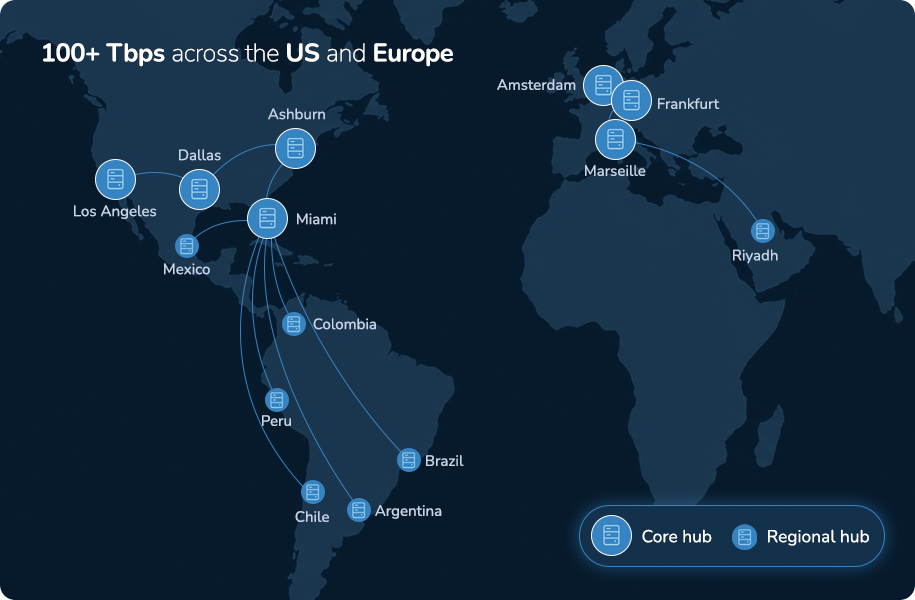
We concentrate compute capacity where demand is highest and size each market around what local workloads actually need. Across the US and Europe, that includes 100+ Tbps of network capacity in major hubs like Los Angeles, Dallas, Ashburn, Miami, Frankfurt, Amsterdam, and Marseille.
With ZEC, you can price a deployment, test its performance and real usage costs, and scale what’s working instead of rebuilding infrastructure in the next market.
It also helps you decide whether a workload truly needs dedicated hardware or is better suited to flexible compute, giving you room to grow without committing to bare metal early.
Building infrastructure that keeps up with unpredictable traffic
Automated traffic is already a major share of internet activity, and more automation is constantly emerging across data collection, monitoring, AI workflows, content discovery, and market intelligence.
That means for access-heavy platforms like VPN, proxy, crawling, and scraping, traffic is becoming more variable and dependent on regional infrastructure environments.
To stay ahead, you need the right capacity in the right markets, a clear read on what scaling actually costs, and a path from POC to production that doesn’t force a rebuild every time.
Over the next two blogs, we’ll show you how to structure regional POCs, evaluate the metrics that matter, and choose a provider that can carry your deployment from testing into production.