
Modern workloads scale dynamically across clouds, regions, and data centers while traditional networks are still bound by long provisioning cycles and inefficient physical builds.
Although enterprises today can deploy infrastructure almost anywhere across public cloud regions, colocation facilities, and edge locations, connecting those environments remains challenging as traditional networks haven’t caught up.
As each connection adds costs, lead times, and operational bloat, the network becomes the limiter, not the multiplier.
Zenlayer Fabric: Connect anything to anything
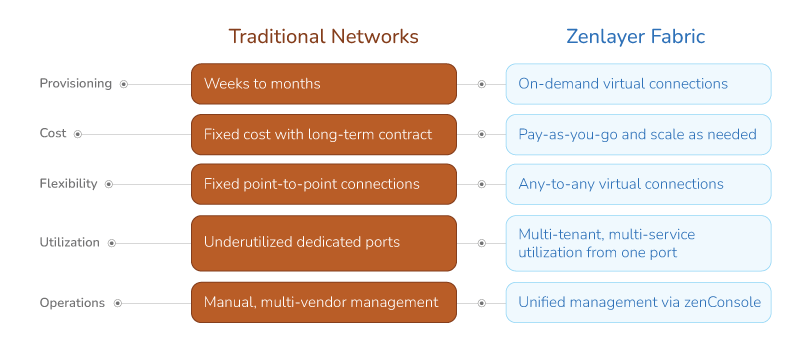
Zenlayer Fabric was built to address the challenges of traditional networking.
As our global backbone network, it lets you seamlessly connect to clouds, data centers, network providers, internet exchanges, and our ecosystem of networking services across regions, giving you a more flexible alternative to fragmented, point-to-point networking for connecting across environments and scaling on demand.
Through Zenlayer Fabric, you gain access to a diverse cloud networking ecosystem with 300+ edge nodes, 300+ cloud onramps, 220+ Tbps capacity, and 10,000+ peering partners, all from a single platform.
Here’s how it compares to traditional networking:
Introducing Zenlayer Fabric Port: One port, unlimited connections
Zenlayer Fabric Port is our newly launched entry point to Zenlayer Fabric.
With a single physical port, you gain access to a global ecosystem of public clouds, network providers, internet exchanges, and data centers, and can seamlessly establish virtual connections on demand without rebuilding the physical network infrastructure each time.
Instead of turning every new connection into a separate infrastructure project, Zenlayer Fabric Port gives you a unified way to scale connectivity across clouds, data centers, providers, tenants, and regions.
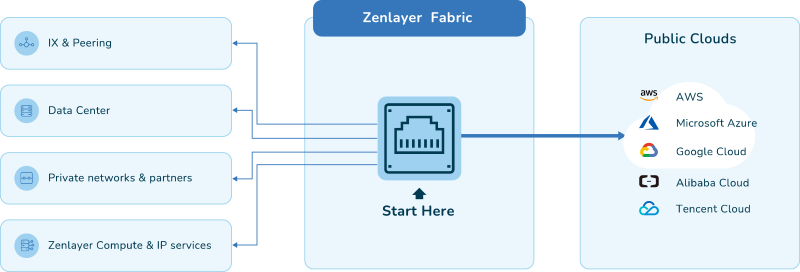
It’s initially available in Singapore, where free built-in metro connectivity helps your business connect across key data centers without additional local bandwidth costs.
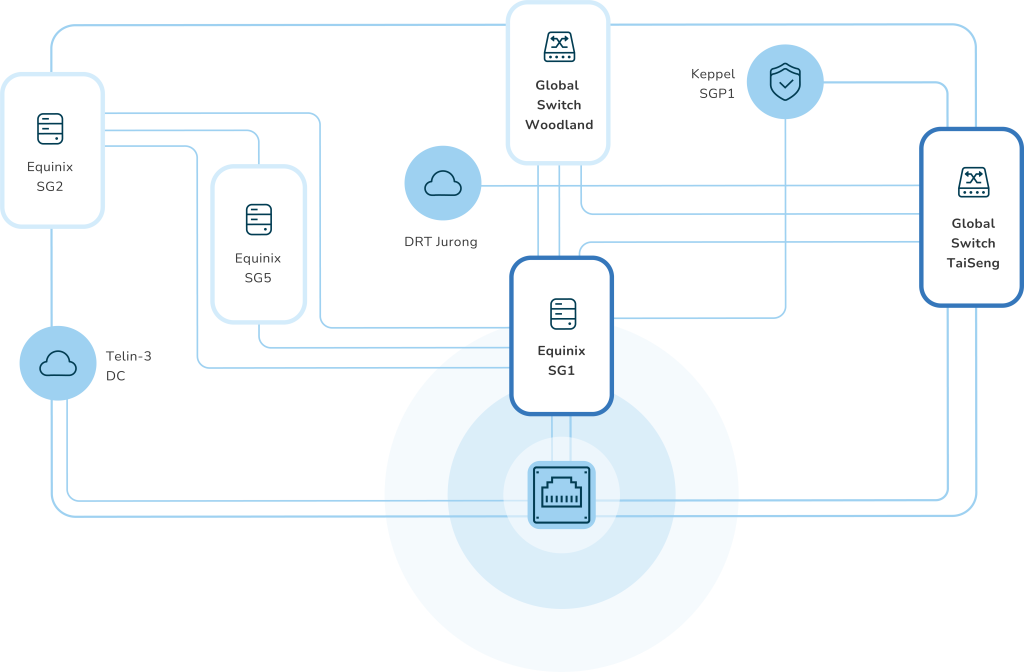
Beyond Singapore, our fabric spanning six continents lets you quickly and reliably extend connectivity worldwide.
Unlocking on-demand connectivity through a single port
Fabric Port employs VLAN-based virtualization, enabling a single physical port to support multiple isolated connections simultaneously. Each connection can be deployed, modified, or decommissioned without involving any new hardware.
Available in 10G, 100G, and 400G options, Fabric Port gives you the flexibility to start with the capacity you need today and scale additional workloads, tenants, or environments through the same physical port while keeping segmentation familiar and manageable.
Simplifying connectivity billing at scale
Traditional connectivity costs balloon as each new connection often demands more bandwidth. This translates to quickly mounting fees from cross-connects, physical port capacity, cabling, fiber optics, provider coordination, installation along with monthly recurring costs and minimum service commitments.
Fabric Port instead uses a fixed monthly port fee with free metro connectivity in Singapore, giving your business a more predictable way to connect local services and interconnect data centers as you grow.
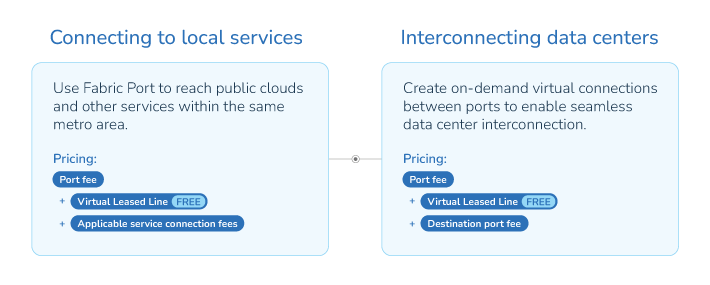
Because multiple services can run through the same port, connectivity becomes more cost efficient the more services you add.
Here’s how businesses are using Fabric Port to simplify connectivity in real-world environments.
Supporting hybrid cloud and DCI services for enterprise customers
Enterprise connectivity requirements rarely look the same from one customer to the next. As operations expand across clouds, data centers, and network services, building a separate connection for each requirement adds deployment complexity and makes hybrid cloud solutions harder to scale.
A solution integrator needed to support enterprise customers across multiple environments, including:
- Public cloud access
- SD-WAN services
- Short-term data migration
- Long-term data synchronization
- Data center interconnection (DCI)
With requirements spanning cloud and data centers, they needed a simpler way to package hybrid cloud connectivity.
To simplify delivery, they used Fabric Port for cloud interconnection and packaged cloud access with DCI services through a unified port-based model. Instead of treating each cloud or data center connection as a separate deployment, they now have a scalable way to support multiple enterprise connectivity scenarios.
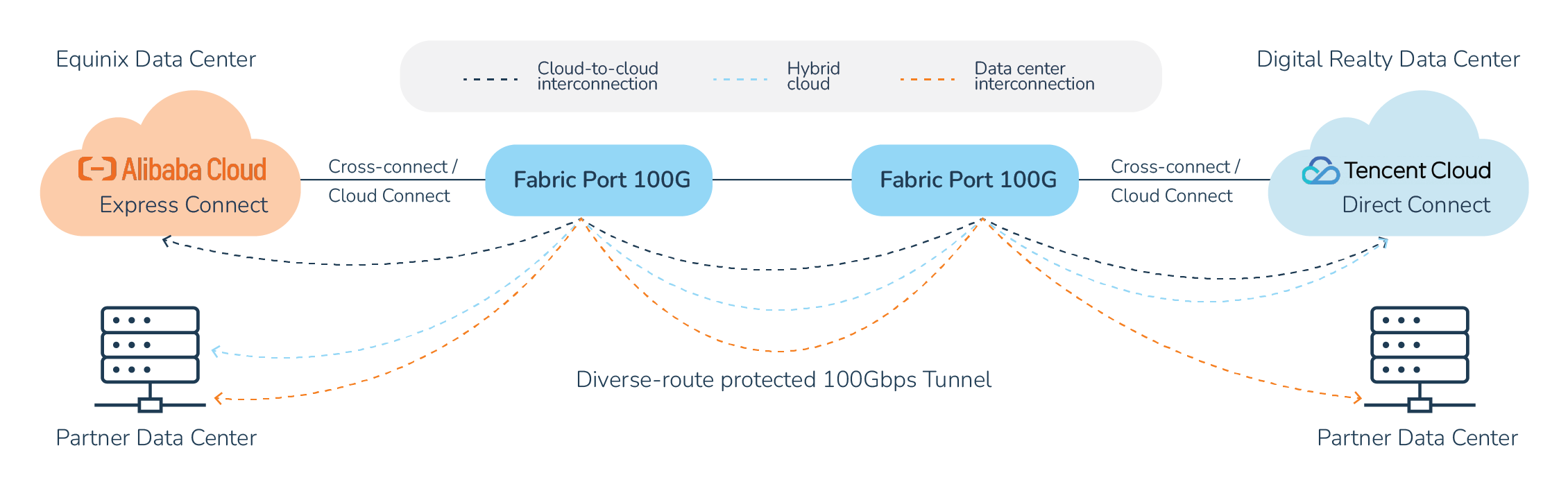
Fabric Port is helping the solution integrator deliver package hybrid cloud and DCI services more efficiently while reducing the complexity of connecting customers across clouds, data centers, and network services.
Scaling data center-to-cloud connectivity for digital media workloads
Short video, livestreaming, and e-commerce platforms need reliable connectivity that can keep up with fast-moving digital workloads and evolving cloud strategies.
A short video and livestreaming platform needed to support data center-to-cloud connectivity, starting with AWS, while preparing for additional cloud access as their operations expand.
They used Fabric Port and Standard Port to connect data center environments with cloud services through a scalable port-based architecture, giving them a more flexible foundation for adding new cloud access locations as business demands grow.
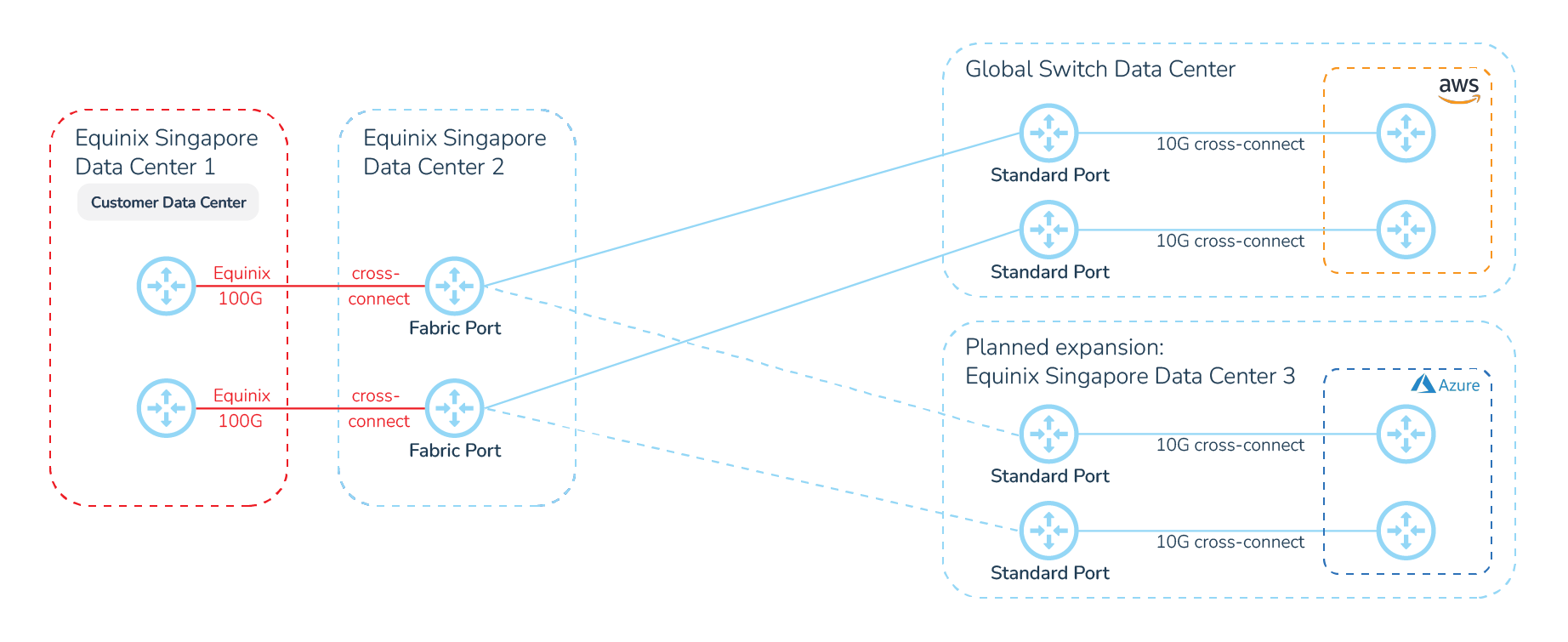
Fabric Port is helping the short video and livestreaming platform better support mixed digital workloads while keeping a clearer path for future multi-cloud connectivity.
Start scaling smarter with Fabric Port
As infrastructure becomes more distributed, networks can no longer be the bottleneck.
Fabric Port gives you on-demand provisioning and unified management through zenConsole, helping you scale more flexibly, efficiently, and predictably. You can expand horizontally across clouds, data centers, and regions through Zenlayer Fabric’s global ecosystem while leveraging 10G, 100G, or 400G port options to support different capacity needs.
A single port becomes your launchpad for network expansion around the world.
Start scaling smarter today. Reach out to a connectivity solutions expert or deploy in minutes via zenConsole, our intuitive self-service platform.